Amalfi Coast Painting: The Story Behind the Lemons, Tiles and Cliff Towns

An Amalfi Coast painting almost always shows the same few things: pastel towns stacked up steep cliffs, glazed tile domes, a deep blue sea – and lemons everywhere. None of these is decoration for its own sake; each comes from centuries of farming, trade and craft on one small stretch of southern Italian coast. Here is the story behind the picture, and how to bring it into your home.
Where the Amalfi Coast is – and why it looks like a painting
The Amalfi Coast (Costiera Amalfitana) is a stretch of roughly 50 kilometres along the southern side of the Sorrento Peninsula, in the Campania region south of Naples, facing the Gulf of Salerno. The mountains drop almost straight into the sea, so towns such as Positano, Amalfi, Ravello, Atrani and Maiori had to grow upwards: houses cling to the rock, streets are often staircases, and one narrow, winding coast road links them all.
That vertical landscape is exactly what makes it so loved by painters. Every view has layers – sea, boats, rooftops, terraces, mountains – and the strong southern light turns pastel walls warm in the evening. In 1997 UNESCO added the Amalfi Coast to its World Heritage List as an outstanding example of a Mediterranean cultural landscape, shaped by people over centuries as much as by nature.
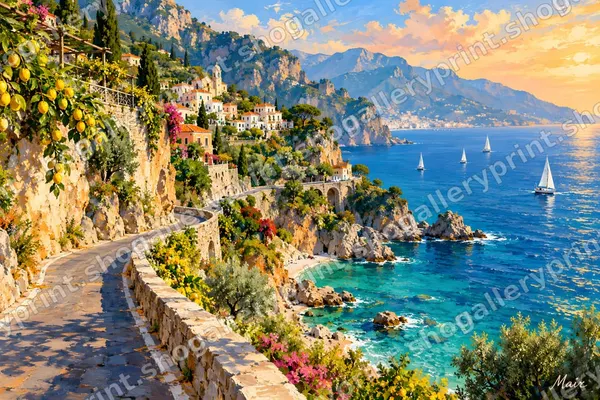
You can see the whole range of these views in our Mediterranean collection, from Positano's tiled dome on the slope to the cliff road wrapped in bougainvillea.
A sea republic: Amalfi's trading past
Today Amalfi is a small town, but in the early Middle Ages it was one of Italy's first maritime republics, alongside the better-known Venice, Genoa and Pisa. From about the 9th to the 11th century its merchants traded across the Mediterranean with Constantinople, North Africa and the Middle East, carrying goods, ideas and styles back home.
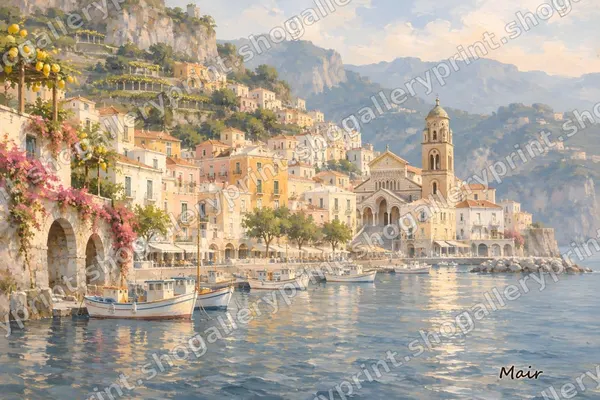
You can still see that past in the town's cathedral, the Duomo di Sant'Andrea, reached by a long, steep staircase from the main square. Its bronze doors are traditionally said to have been cast in Constantinople in the 11th century, and its striped, arched façade – largely rebuilt in the 19th century in the old Arab-Norman style – mixes Byzantine, Islamic and Romanesque ideas in a way that feels typical of this coast. It is a favourite subject for artists; our striped cathedral façade print is inspired by that look.
Amalfi's sailors are also often linked with the spread of the magnetic compass in Europe. The details of that story are debated by historians, but the town still proudly remembers it.
Why there are lemons in every Amalfi Coast painting
The lemons are not an artist's invention. The coast grows a famous local variety, the Sfusato Amalfitano – a large, spindle-shaped lemon with a thick, fragrant skin and a sweet, mild juice. It is protected in the EU with a PGI label (Limone Costa d'Amalfi IGP), and its neighbour across the peninsula, the Sorrento lemon, has its own protected status.
Because the slopes are so steep, the lemons grow on narrow terraces held up by dry-stone walls and covered with pergolas of wooden poles. Traditionally farmers spread straw mats or nets over the pergolas to shelter the trees from wind and cold; today you still see green nets over the groves from the coast road. Much of the work is done by hand, and it is often said that carriers once took the harvest down the steps on their shoulders in heavy baskets.
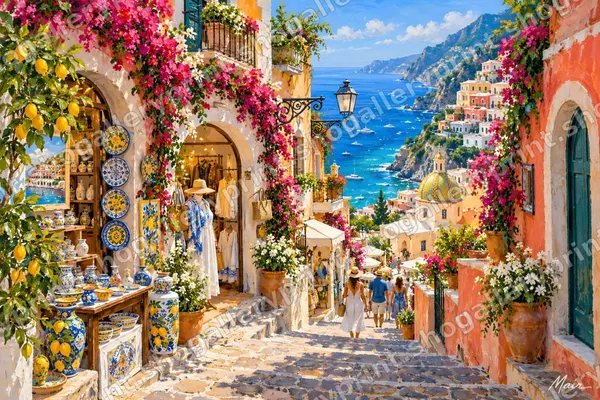
Lemons became part of everything here: lemon granita, lemon cakes and, of course, limoncello, the sweet lemon liqueur served cold after dinner. Amalfi, Sorrento and Capri all claim to be its home, and no one has settled the argument. If you love this side of the coast, our lemon market stall with blue pottery and the lemon terraces above the coast road are two of the most cheerful pieces of lemon wall art in the shop.
Majolica: the glazed tiles of Vietri and the domes of Positano
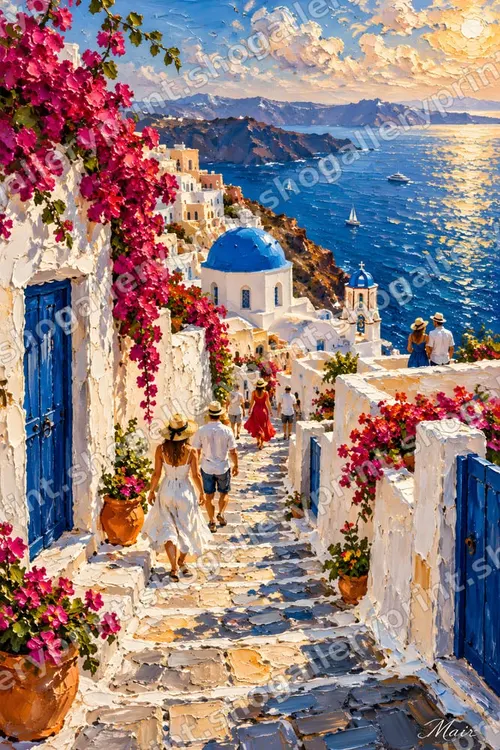
The second thing you notice in almost every Amalfi Coast scene is colour on the rooftops. Many churches along the coast have domes covered in glazed tiles – yellow, green and blue – that shine in the sun. The best-known is the dome of the church of Santa Maria Assunta in Positano, which dominates the town's beach and countless postcards.
Those tiles belong to the tradition of majolica, tin-glazed earthenware painted in bright colours. At the eastern end of the coast, the town of Vietri sul Mare has been known for ceramics for centuries, and its workshops still make hand-painted plates, jugs and tiles with lemons, fish, donkeys and sunny country scenes. Walk through any coast town and you will see ceramic house numbers, tiled benches and shop doorways stacked with pottery.
Our ceramics lane with lemons and ceramic stairs with lemons pick up those patterns, and they sit beautifully in a kitchen next to real blue-and-white pottery.
How to decorate with Amalfi Coast and Italian wall art
Amalfi colours – lemon yellow, sea blue, terracotta and white – are some of the easiest to live with. A few ideas that work in real homes:
- Kitchen and dining room: lemons and ceramics feel natural near food. A single lemon terrace or market-stall print over a sideboard brightens the room all year.
- Living room: choose a wide harbour or cliff-town view as one large piece over the sofa, so the layered landscape can breathe. Our wall art for living room ideas post explains sizes and spacing.
- Bathroom and hallways: blue sea views and white steps keep small rooms light and calm – the same trick as on the white and blue Greek islands.
- A small Italian gallery wall: mix two coast scenes with one Tuscan still life and one lake view, framed in the same white or natural-wood frame to tie them together.
For more combinations, see our guide to Mediterranean wall art ideas. Our designs are digital artworks created with the help of AI tools and refined by our small family studio, then sold as print-ready files or as printed canvas, posters and pillows – see print sizes and frames to choose the right size.
Free Amalfi Coast printables
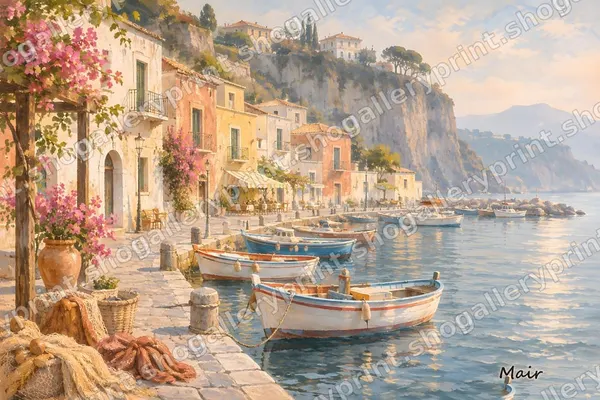
If you would like to try the look before buying, our free library has a whole Amalfi and Italian coast collection of printables, including the lemon terraces, Amalfi harbour with its bell tower and the fishing boats of Sorrento's Marina Grande. Print one at home or at a local print shop, live with it for a few weeks, and see how the colours feel in your room. There are also free sets for the Greek islands and for Tuscany and the Italian lakes if you want to build a wider Mediterranean wall.