Aztec Art Explained: Eagles, Feathered Serpents and the Sun
Aztec art is the bold, symbol-packed visual language of the Mexica people, who ruled central Mexico from their island capital Tenochtitlan until the Spanish conquest of 1521. It was made to speak of gods, the sun, war and the founding of their city – which is why eagles, feathered serpents and warriors appear again and again. Here is how to read it, how it differs from Maya art, and how to live with it today.
Who made Aztec art – and where
The people we call the Aztecs called themselves the Mexica. According to their own tradition, they wandered for generations until they saw the sign their god Huitzilopochtli had promised: an eagle perched on a cactus growing from a rock in a lake. There, on an island in Lake Texcoco, they founded Tenochtitlan – traditionally dated to 1325 – which grew into one of the largest cities in the world of its time, on the site of today's Mexico City.
Aztec art flourished mostly in the 1400s and early 1500s, when the Mexica and their allies controlled a large tribute empire. Skilled artisans worked in stone, gold, turquoise mosaic, clay and – most prized of all – feathers. Much of what survives today was found in and around the Templo Mayor, the great twin temple at the heart of the city, excavated since the late 1970s and now a museum in central Mexico City.
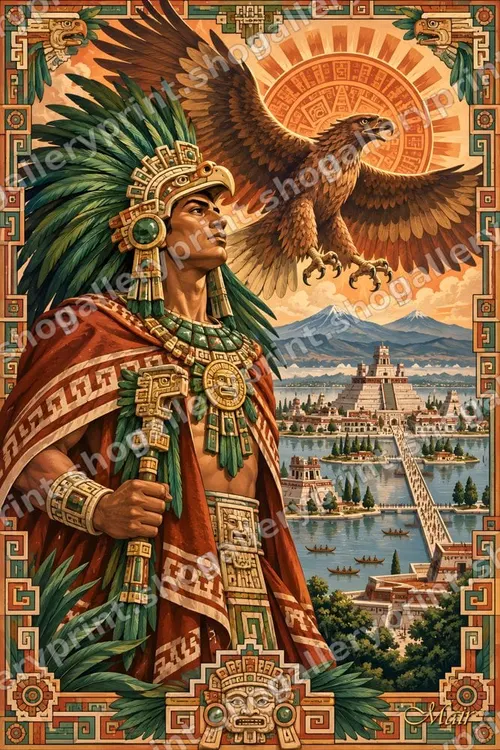
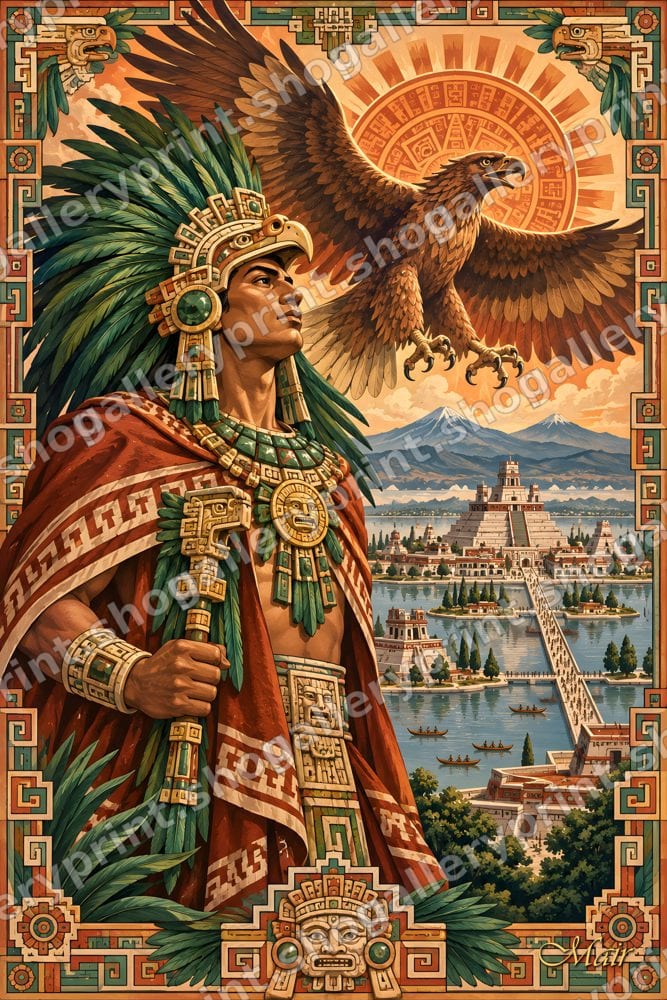
The eagle on the cactus still lives on: it sits at the centre of the Mexican flag. Our Aztec Eagle Warrior over Tenochtitlan imagines that island city with its temples in the background.
The main symbols in Aztec art
Aztec art is easy to love and a little harder to read, because almost every element carries meaning. A few symbols you will meet everywhere:
- The eagle – linked to the sun and to Huitzilopochtli, the god of sun and war. It stands for strength, the rising sun and the founding of Tenochtitlan.
- The feathered serpent (Quetzalcoatl) – a snake covered in the green feathers of the quetzal bird. He was a god of wind, wisdom and learning, honoured across Mesoamerica long before the Aztecs; the Maya knew a similar god as Kukulkan.
- The sun – the Aztecs believed the world had passed through several "suns" or ages, and that the sun needed constant offerings to keep moving across the sky.
- The jaguar – a symbol of night, power and the elite warriors who wore its skin.
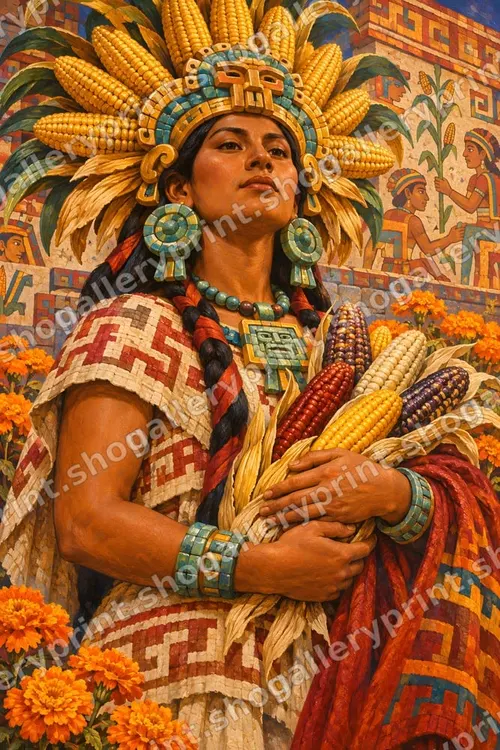
- Maize – the corn that fed everyone, honoured through maize deities and corn-shaped ornaments.
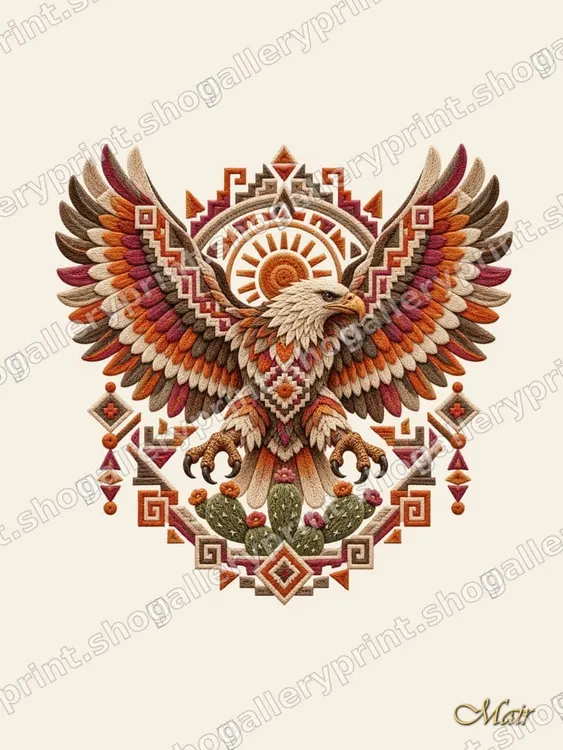
You can see several of these in our Feathered Serpent, Quetzalcoatl and the Eagle & Golden Sun.
The Sun Stone: the most famous Aztec painting in stone
If one object sums up Aztec art, it is the Sun Stone (Piedra del Sol), a carved basalt disc about 3.6 metres across, found in Mexico City's main square in 1790 and now in the National Museum of Anthropology. It is often called the "Aztec calendar", but most scholars see it less as a working calendar and more as a monument to the sun and to the Aztec idea of time and the ages of the world. A face at the centre – usually identified as a sun or earth deity – is ringed by the signs of the 20 day names.
Like much Aztec sculpture, it was originally painted in bright colours; researchers have studied traces of pigment on its surface. So the picture many people have of Aztec art as plain grey stone is only half the story – the real thing was vivid. That is one reason a colourful Aztec painting or modern piece of Aztec wall art can feel true to the spirit of the originals.
Eagle and jaguar warriors in Aztec art
Among the best-known images in Aztec art are the eagle warriors and jaguar warriors, the two most famous military orders of the Mexica. A warrior earned his place mainly by taking captives in battle, and was then allowed to wear the costume of his order: a helmet shaped like an eagle's open beak, or the spotted skin of a jaguar. Life-size clay eagle warrior figures were found at the Templo Mayor complex and are among the finest Aztec sculptures that survive.
Nobles and warriors also wore featherwork – shields, headdresses and tunics covered in the shimmering green, blue and red feathers of tropical birds, brought in as trade and tribute from the southern lowlands. Feather artists (amanteca) were highly respected, and the few feather pieces that survived the conquest are now museum treasures.
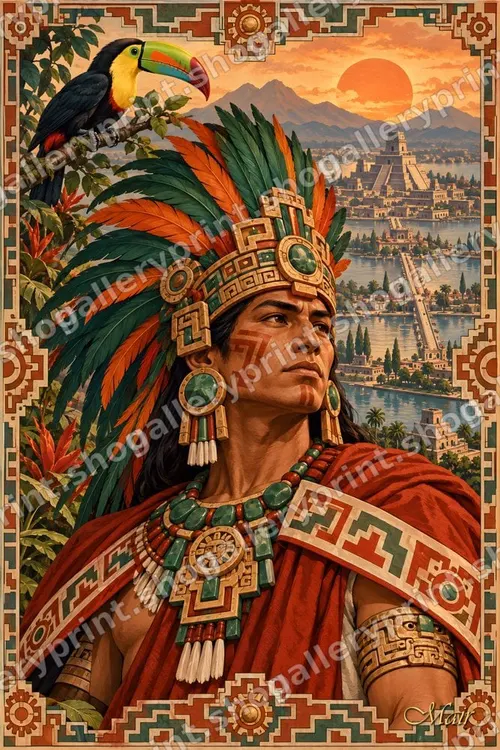
If you are looking for an Aztec warrior painting for a study or living room, browse Aztec Warrior, Green Feathers or the more playful Aztec Warrior & Toucan City.
Aztec art vs Maya art: what is the difference?
People often mix the two, and the confusion is understandable – both belong to the wider Mesoamerican world, share gods like the feathered serpent, and used a 260-day ritual calendar. But they are different peoples, places and eras:
- Place: the Maya lived in the south – Yucatán, Chiapas, Guatemala and Belize. The Aztecs ruled from the central highlands of Mexico.
- Time: Maya city-states such as Tikal and Palenque peaked in the Classic period, roughly 250–900 AD, centuries before Tenochtitlan was founded. Maya communities and languages are very much alive today.
- Style: Maya art is famous for graceful carved portraits of kings, painted pottery and murals with long hieroglyphic texts. Aztec art tends to be more monumental, geometric and bold.
Our earlier post on jade, quetzal feathers and cacao covers the Maya side; the Jade & Jaguar collection brings both worlds together.
Bringing Aztec wall art into your home
Aztec imagery is strong, so a little goes a long way. A few tips:
- One hero piece. A single large eagle or warrior print above a sofa or console makes more impact than many small ones – see our print sizes and frames guide.
- Pick up the colours. Turquoise, jade green, gold and terracotta work beautifully with wood, clay pots, woven throws and plants.
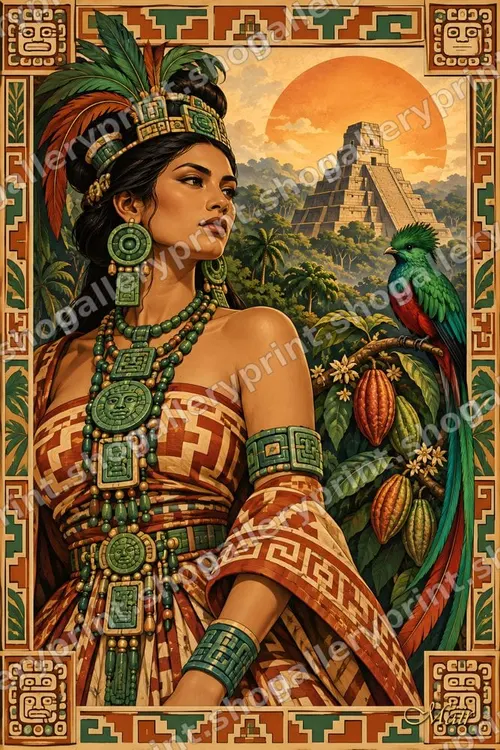
- Mix with softer pieces. Pair a bold warrior with a gentler image such as the Aztec Maize Goddess, or add an eagle and sun pillow to repeat the theme.
- Respect the culture. These are sacred and national symbols for many people of Mexican heritage; treat them as art to admire, not as a joke or a costume.
Our designs are digital artworks created with the help of AI tools and refined by our small family studio – inspired by the history above, not copies of museum objects. Several are free to print at home in the Maya, Aztec & Inca free printables, and for more decorating ideas read Latin American wall art ideas.